
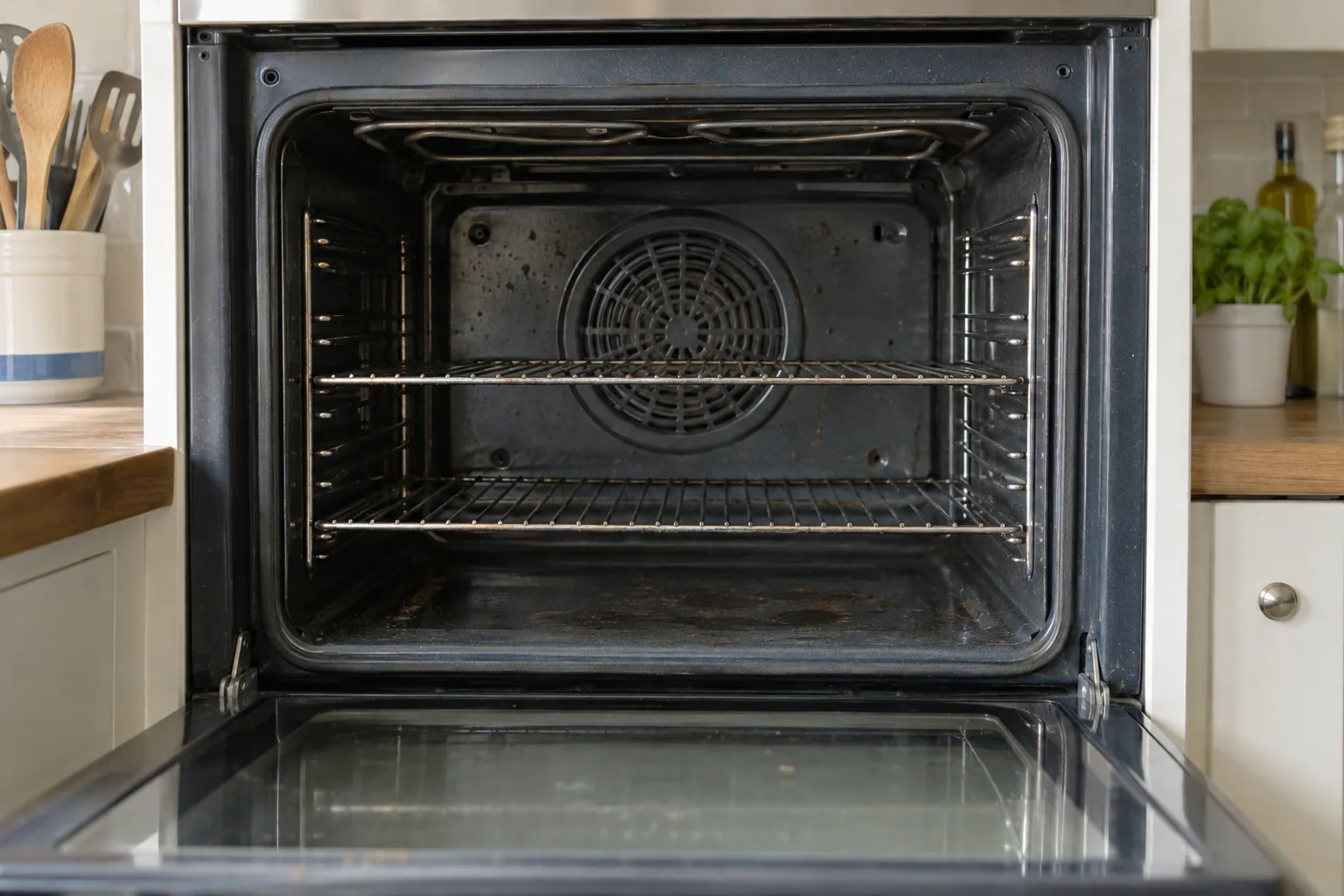
A safe home clean for an electric oven starts with the appliance switched off, completely cool and treated according to its manual. Remove loose food and approved removable accessories, then clean accessible glass and enamel with a soft cloth and a product suitable for those finishes. Keep liquid and cleaner away from heating elements, fan openings, controls and electrical fittings. Do not remove panels or wires to reach a stain.
Electric ovens look straightforward because much of the cavity is a continuous surface. The less obvious parts are what make a rushed clean risky. A fan sits behind a guard, elements can be exposed or concealed, and some liners have coatings with specific care requirements. Scrubbing everything with the same pad may damage a finish without removing the real source of a smell. A measured approach makes the result both cleaner and safer to use.
Check the oven before choosing a method
Find the model number and read the cleaning section of the manufacturer’s instructions. Check whether the oven has catalytic liners, a pyrolytic programme, a steam-assisted programme or conventional enamel. Each changes what you should remove, which surfaces can be wiped and whether a particular cleaner is suitable. A self-cleaning label is not a licence to run a cycle through spilled sauce and loose crumbs without preparation.
Look at the cavity while it is cold. Is the dirt a thin grease film, a hard patch of burnt food, a splash on the inner glass or residue around the fan guard? Different deposits need different attention. A stain that appears to be inside the door glass is inaccessible from the exposed pane. A dark patch behind a fixed panel may remain inaccessible without service work. Identify these limits before you start, rather than deciding midway through cleaning to take the appliance apart.
Gather a soft cloth, a non-scratch sponge if the manual allows one, a small bowl of clean water and a product approved for the surface you will clean. Read both the oven manual and the product label. Do not mix products, especially bleach with acidic or ammonia-based cleaners. Even ordinary household products can leave strong odours if not rinsed as directed. Good ventilation helps, but it does not make an unsuitable chemical safe for an oven coating.
Remove loose material and accessories
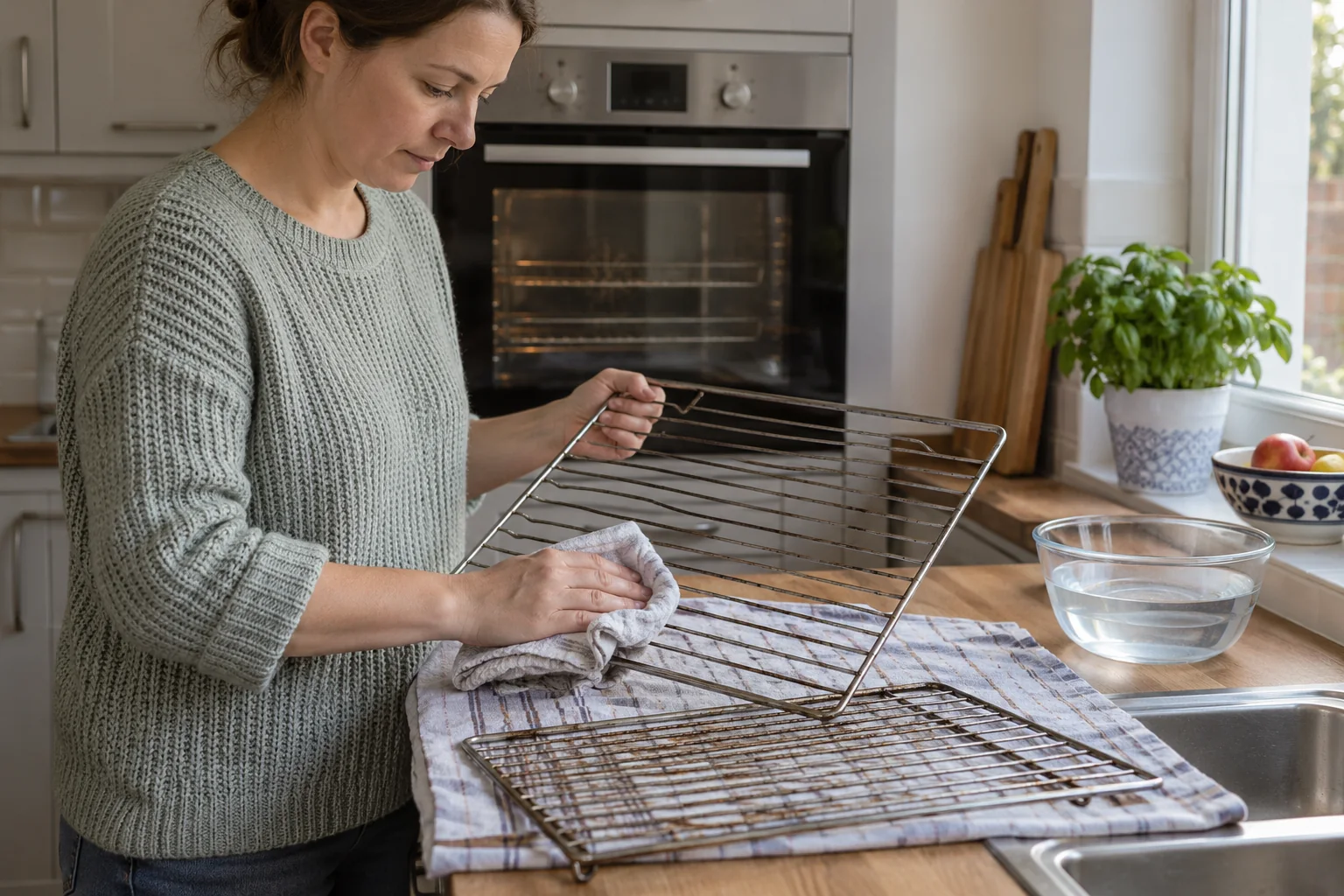
Take out trays, racks and shelves the manual says can be removed. If telescopic runners are attached, check whether they stay in place or come out as an assembly. Some mechanisms should not be soaked or treated with aggressive degreasers. Clean removable pieces over a protected worktop, using the method allowed for their finish, and dry them completely before refitting. Avoid forcing a shelf that does not move freely; it may have a stop or a prescribed angle for removal.
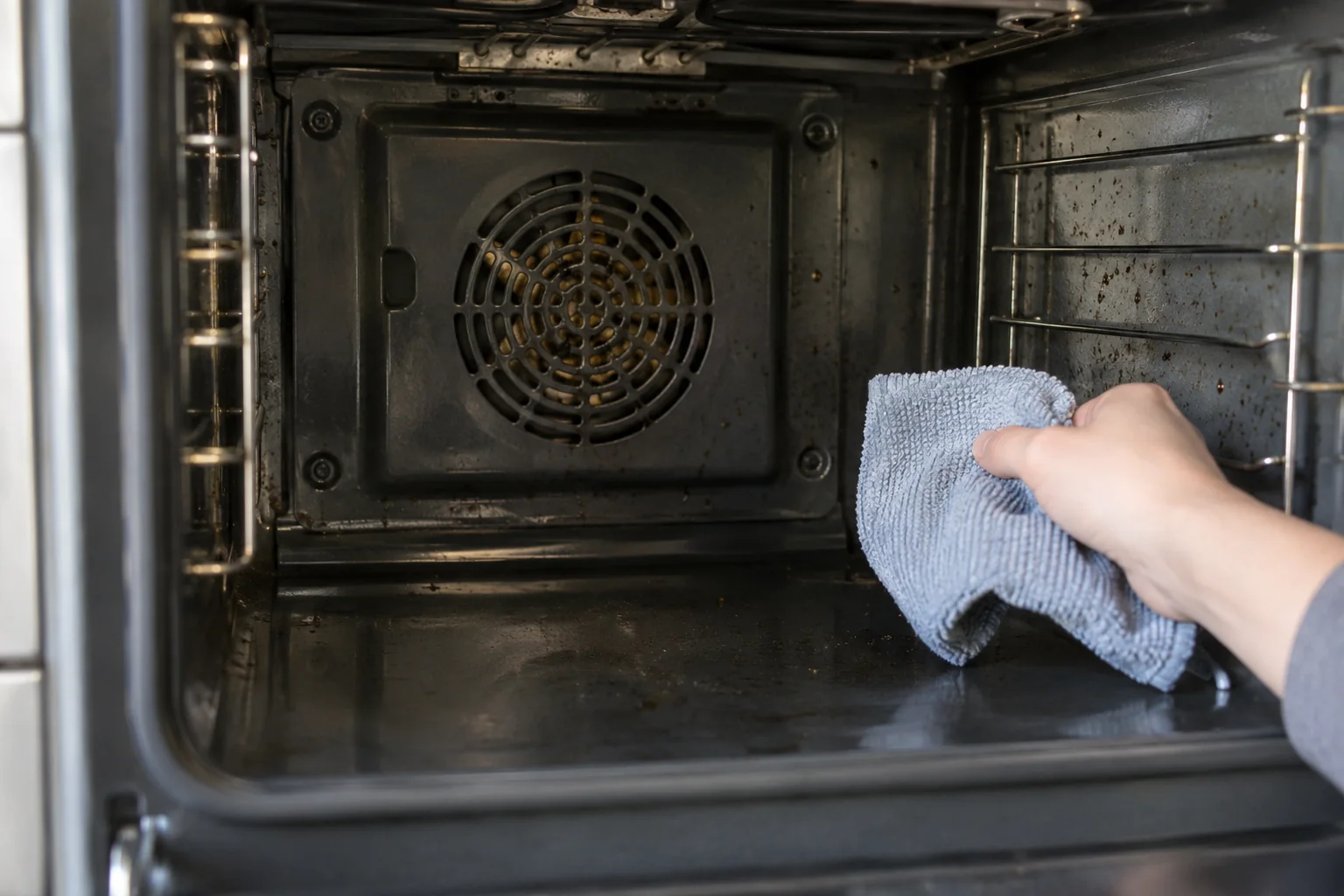
Lift out loose crumbs with a dry cloth or a soft brush. Work away from the fan opening, lamp and element connections so debris does not collect in a recess. Then wipe accessible enamel with a slightly damp cloth. The aim is to remove movable soil before applying cleaner to a stubborn patch; otherwise a paste of crumbs and grease can be spread around the cavity. If the oven floor has pooled fat, absorb it with a cloth before trying to loosen hardened marks beside it.
Treat baked-on residue patiently. Use only a cleaner compatible with the specific surface and allow it the contact time stated on its label. Applying extra pressure or extending contact indefinitely can harm a finish. If the manufacturer recommends a different method, follow the appliance instructions. A metal scraper that seems effective on a tray can scratch enamel or glass. An abrasive sponge may dull stainless trim or a coated liner permanently.
Protect elements, fan and electrics
Exposed heating elements should not be scrubbed, bent or coated in cleaner. If a residue has reached an element, consult the manual for the approved response. Do not reach behind it or detach it unless the instructions specifically permit that action and you can complete it safely. An element can be damaged by mechanical pressure even when the oven is switched off and cold.
The fan guard is another boundary. You may be able to wipe the accessible surface around it, but do not push wet cloth fibres or cleaning paste through its openings. The guard protects moving parts and wiring. Removing it can be a model-specific service procedure rather than an ordinary cleaning step. The oven light and its cover also deserve care; check whether the cover can be wiped in place and avoid forcing it loose for the sake of a small mark.
Use little liquid around the control fascia and door edges. Spraying directly at knobs and buttons can send cleaner behind them. A dampened cloth gives more control. On the door, wipe the exposed glass gently and keep the lower edge dry enough that water does not run into the panel assembly. If grease is trapped between panes, follow the manual’s door-access instructions or arrange help. A clean outer pane cannot reach an inner mark.
After an approved cleaning product has worked, remove it with clean damp cloths as directed. Change the cloth or rinse it often, then dry accessible surfaces. Inspect the cavity for cleaner residue, loose crumbs and cloth fibres. Allow the oven to air fully before use. A strong chemical smell on first heating suggests residue remains; turn the oven off, let it cool and follow the product and appliance instructions rather than trying to burn the smell away.
Choose cleaning cycles carefully
Some electric ovens include pyrolytic cleaning, which uses very high heat to reduce suitable residue to ash. It has its own preparation rules for racks, accessories, loose food and nearby ventilation. Other ovens use steam to soften light soil, followed by a manual wipe. Catalytic panels rely on a special coating and need different handling again. These systems are not interchangeable, and a manual for a similar-looking oven may still specify different steps.
Do not start a high-temperature cycle if there is a large spill or a damaged door seal. Read the manufacturer’s restrictions and make sure the kitchen can be ventilated as instructed. A self-clean cycle may produce odours, and it does not repair a faulty fan or door. If the oven is already smoking heavily, stop using it until the source has been assessed. Repeating a cycle without removing accessible debris may make the problem worse.
When to ask for help
An electrical fault, damaged cable, tripping circuit, flickering control or unusual fan noise needs appropriate repair, not a deeper clean. Stop using the oven and follow the appliance manufacturer’s guidance. Do not test a suspected fault by running the oven empty after adding cleaner or water. If a component must be opened or replaced, use a suitably qualified appliance professional.
For heavy grease on accessible surfaces, professional oven cleaning can be useful when a home clean would mean hours of scrubbing near delicate parts. Tell the cleaner about the oven’s model and any special liners or cleaning function. Keep repair needs separate: a cleaning service may remove soil, but a technician addresses a failing heating element, wiring or controls. If the kitchen needs attention beyond the oven, kitchen cleaning is a separate service with a wider scope.
Make future cleaning easier
Once the oven is back in normal use, remove small spills after the appliance has cooled. Choose dishes deep enough for bubbling food, avoid filling them to the brim and clear loose crumbs before they are reheated. Do not cover the oven floor with foil unless the manual allows it; foil can alter heat flow and may damage surfaces. A quick check of glass, side walls and floor after messy cooking tells you whether a light wipe will be enough.
The simplest routine is to keep ordinary residue from becoming carbonised while leaving the oven’s electrical parts alone. Clean the surfaces you can reach and are permitted to clean, use the manual for the rest, and treat a fault as a repair question. That boundary protects the appliance while giving you a realistic route to a fresher oven.