
Telescopic runners make a heavy oven shelf easier to pull forward, but their sliding tracks need more care than a plain wire rack. Let the oven cool fully, check the model's removal and cleaning instructions, lift off loose crumbs, and wipe only the accessible track surfaces with a soft, barely damp cloth if the maker permits it. Do not soak or spray a runner unless the instructions expressly allow that method. Water, strong cleaner or grease remover inside a sliding mechanism may affect its bearings or factory lubrication.
Identify what can be removed
Open the cool oven and pull the shelf forward only as far as its normal stop. Look at how the shelf sits on the telescopic arms. On some models the wire shelf lifts off while the runners stay attached to the side supports; on others the supports or complete runner assembly can be released. The mechanisms are not interchangeable. Find the appliance model number and read its manual before touching a clip or rail. A diagram is particularly helpful for refitting the correct side at the correct height.
Check whether the runners are approved for a self-cleaning cycle. Many removable accessories must be taken out before pyrolytic cleaning, but requirements vary by model. Do not leave a telescopic runner in a hot cleaning cycle merely because the plain rack can tolerate it. Equally, do not remove a support if the maker says it should remain in place. A small step in the manual can protect the smooth movement that makes the accessory useful.
Inspect the runners before cleaning. A little surface grease is different from a rail that is bent, jammed, grinding or missing a fixing. Cleaning cannot straighten damaged metal or restore a failed bearing. If a shelf tilts when extended or feels insecure, avoid loading it and seek the manufacturer's replacement or repair guidance. Record which side and level are affected so you do not confuse matching parts during a later inspection.
Set up a safe place for the shelf
Make sure the oven and every metal part are cold. Clear a stable worktop and lay down a towel or protective mat that will not scratch the shelf. Keep a small bowl of water and cloths away from the open oven so they cannot spill into the cavity. Do not use the open door as a workbench or lean on it while reaching for a clip. If the shelf is heavy, use both hands and ask for help rather than twisting it out of the rail.
Gather a soft brush for dry crumbs, clean microfibre cloths and a mild cleaner only if the manual permits it. Read the product label for suitable materials and rinsing. Keep strong oven cleaner, aerosol sprays, steel wool and abrasive pads away from the sliding track. A product may be safe for an oven wall but unsuitable for plated rails, bearings or a protected finish. Never mix cleaning chemicals or add household acids to a product already present.
If the shelf separates from the runners, clean the wire shelf according to its own care instructions. Some racks may be washed or soaked, but the runner assembly may not. Keep the two tasks distinct. A bowl, bath or dishwasher method recommended for a plain rack should not be extended to a telescopic mechanism by assumption. Dry the shelf fully before putting it back so trapped water does not drip onto the rails.
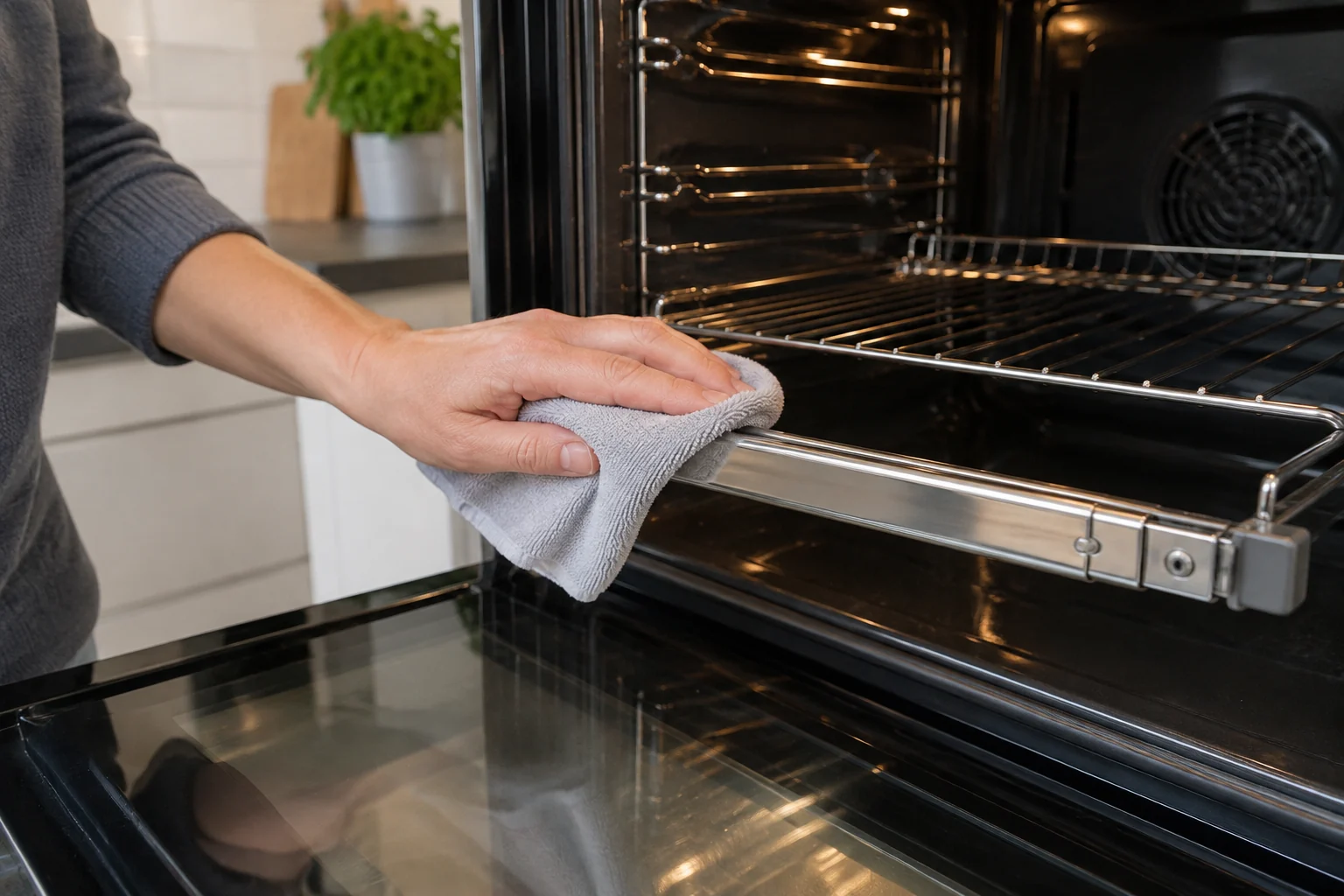
Clean accessible tracks with minimal moisture
Use a dry soft brush or cloth to lift loose crumbs from the exposed track. Move from the inner end towards the open side, where you can collect the debris, rather than forcing particles deeper into the mechanism. Avoid stiff bristles that could scratch or lodge in a narrow channel. If a crumb cannot be reached without poking inside the bearing area, leave it and consult the maintenance instructions.
Where the manual allows damp cleaning, moisten a soft cloth and squeeze it until it cannot drip. Wipe the visible upper and outer faces of the rail in short strokes. Fold the cloth to reach a flat exposed lip, but do not push it into a tight slot. A cotton bud can shed fibres and a pointed tool can dislodge a small component, so neither is a good default. Keep the contact gentle and inspect the cloth as it picks up grease.
For a sticky spot on an accessible surface, hold the slightly damp cloth on it briefly if permitted, then wipe again with light pressure. Do not flood the track in an attempt to dissolve residue. Grease may travel into the bearings and return as a dirty streak later. A rail that remains sticky after cautious surface cleaning is a reason to seek model-specific advice rather than increase the amount of cleaner.
Do not add oil or household lubricant unless the manufacturer specifies a product and procedure. The runner may have sealed bearings or factory-applied lubricant that reacts badly to other substances. A runner that squeaks after cleaning may need inspection or replacement, not an improvised spray. Likewise, forcing a stiff runner in and out to “work in” a cleaner can worsen a bent or misaligned part.
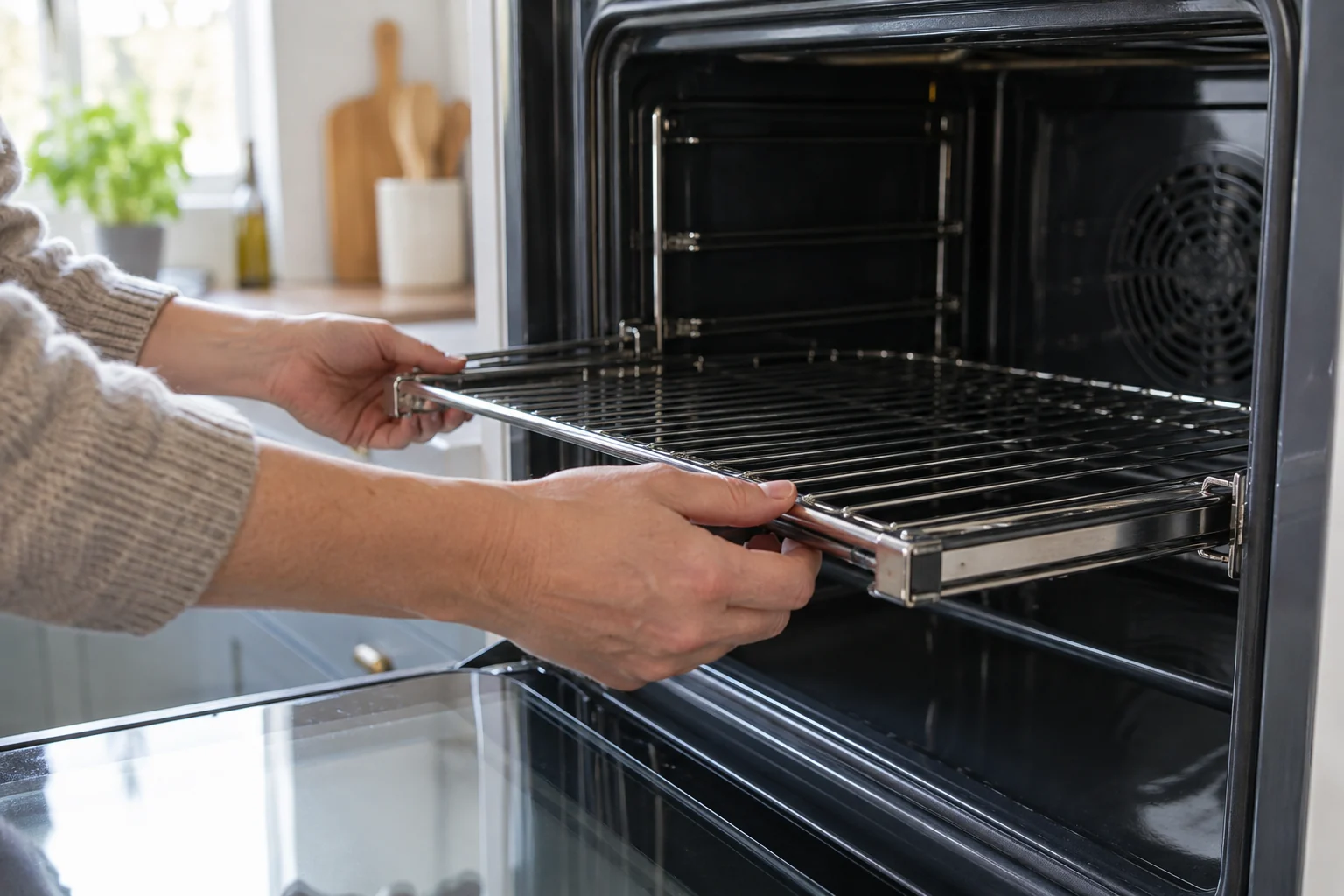
Dry, refit and test without a load
Use a separate dry cloth on every accessible wiped surface. Give any remaining moisture time to evaporate in accordance with the manual before using the oven. Check that no cloth fibres remain on a rail and no water has run into its channel. An oven may appear dry from the front while an inner lip is still wet. A careful final look with a torch is more useful than turning the appliance on to force it dry.
If you removed the shelf or runner, follow the model's fitting diagram step by step. Make sure left and right parts return to their correct sides and heights, and that every specified clip or stop is engaged. Do not assume a runner is secure because it slides once. Pull it forward slowly without a tray, then push it back. It should move smoothly, stay level and stop where designed. If it catches or wobbles, stop and recheck the fitting instructions.
Only after the unloaded test should you replace a light shelf or tray and check its travel within the weight limit specified for the appliance. Never sit a heavy roasting tin on an extended shelf to test it. If a rail drops, tilts or binds, remove the load and seek repair advice. A telescopic shelf is meant to support cooking safely; its appearance after cleaning is secondary to its secure movement.
If the oven cavity also has heavy grease, a professional oven cleaning service may help with accessible surfaces. Tell the provider that the oven has telescopic runners and ask how those parts will be handled. Some jobs may include the wire rack but exclude delicate sliding mechanisms, depending on the model and service scope. A cleaner cannot repair a worn runner, so describe any movement problem separately to the manufacturer or repairer.
For routine care, catch accessible crumbs after the oven cools, wipe light splashes before they bake on repeatedly and keep bulky trays from striking the rails. Avoid liners that obstruct airflow or touch a moving mechanism unless the appliance maker allows them. The most useful cleaning routine is modest: identify the assembly, protect its moving parts, dry the exposed surfaces and confirm that the shelf still travels securely when refitted.